Burst Pipe Water Damage in Kennesaw, GA
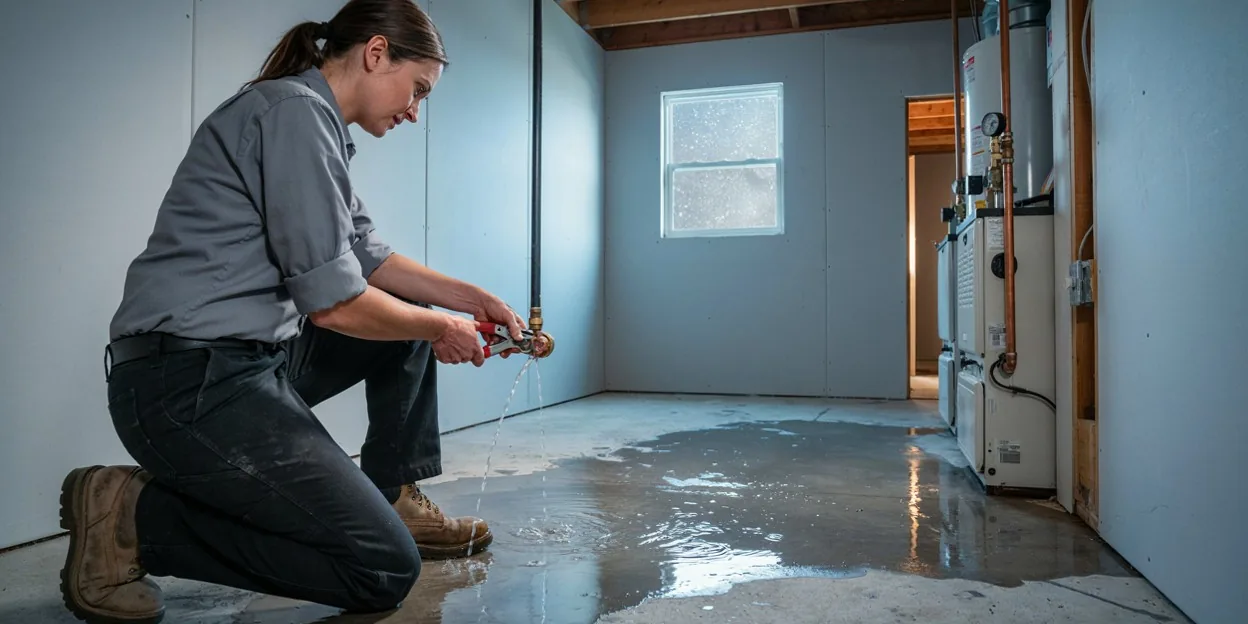
The ceiling in the upstairs hall started dripping at six in the morning, and by the time you found the valve the dining room light fixture below it was full of water. This site connects you by phone with an independent local provider who handles burst pipe water damage in Kennesaw and across Cobb County.
Tracing the line from the split to the lowest wet spot
The plumber fixes the pipe. The provider deals with everything the water touched on its way down, and the first job is finding out how far that is. The crew starts at the split and follows gravity: the attic insulation under a frozen line, the ceiling drywall below it, the wall cavity the water ran down inside, the floor at the bottom of that wall, and on a two-story house the ceiling of the room under that.
Every one of those gets a meter reading against a dry reference. A wall that shows no stain can read soaked at the bottom plate because the water ran inside the cavity and never touched the paint. Those readings, along with how long the line ran before the valve was found, set the scope.
Finding the valve, and what to do after you find it
The main shutoff is usually where the line enters the house, in the crawl space, the basement, or the garage wall, and there is a second one at the meter box by the curb. Close it. Open the lowest faucet in the house to drain the lines. Turn off the breaker for any room where water reached a fixture or an outlet, and do not touch a light fixture that is holding water. Poke a small hole in a bulging ceiling with a bucket underneath so it drains instead of dropping all at once. Photograph each wet room, then call.
Ceilings, cavities, and carpet: what stays and what comes out
Ceiling drywall that sagged or held water comes out; drywall that only got damp along a seam often dries with an air mover directed into the cavity. Wall cavities get opened at the bottom where the water collected, and wet insulation comes out because it does not dry in place. Hardwood on the floor below can sometimes be saved with a mat drying system if the crew gets there the same day. Carpet pad under a wet spot usually goes.
The drying that follows is the same structural drying process used on any loss, with the dehumidifiers doing the heavy lifting in a closed house. If the split was in a supply line under the floor rather than above it, the water ended up in the crawl space, and crawl space water extraction takes over below. If a first-floor line flooded a living room, water extraction is the first step before any of this.
Attic lines, garage tanks, and the freeze of December 2022
Kennesaw winters are mild enough that builders from the 1980s through the 2010s ran supply lines through attics and exterior walls with little insulation around them, and that works until the year it does not. On December 23 and 24, 2022, the metro dropped to 8 degrees with wind chills below zero, and lines split in attics, garages, and exterior walls across Cobb County. Many of them let go a day later when the ice thawed and the pressure came back, so the leak started while people were away for the holiday and ran for hours.
The other common Kennesaw failure is not weather at all. A plastic supply line to a second-floor bathroom fails at a fitting, a braided washer hose lets go in an upstairs laundry, or a refrigerator line splits behind the fridge, and the water lands on the subfloor and heads for the room below. The two-story-over-crawl-space houses that fill the subdivisions between Barrett Parkway and Lake Allatoona give that water three levels to travel.
A burst line is a sudden loss, which is the kind many homeowner policies respond to, but a line that froze in an unheated house or dripped for months is often treated differently. Ask the crew for the moisture log and the photos on day one.
When you call about a line that let go
Have the address ready and say where the pipe is, whether the water is off, how long it ran, and which rooms below it are wet. Mention a ceiling that is sagging or a fixture holding water. Call (470) 574-4769.